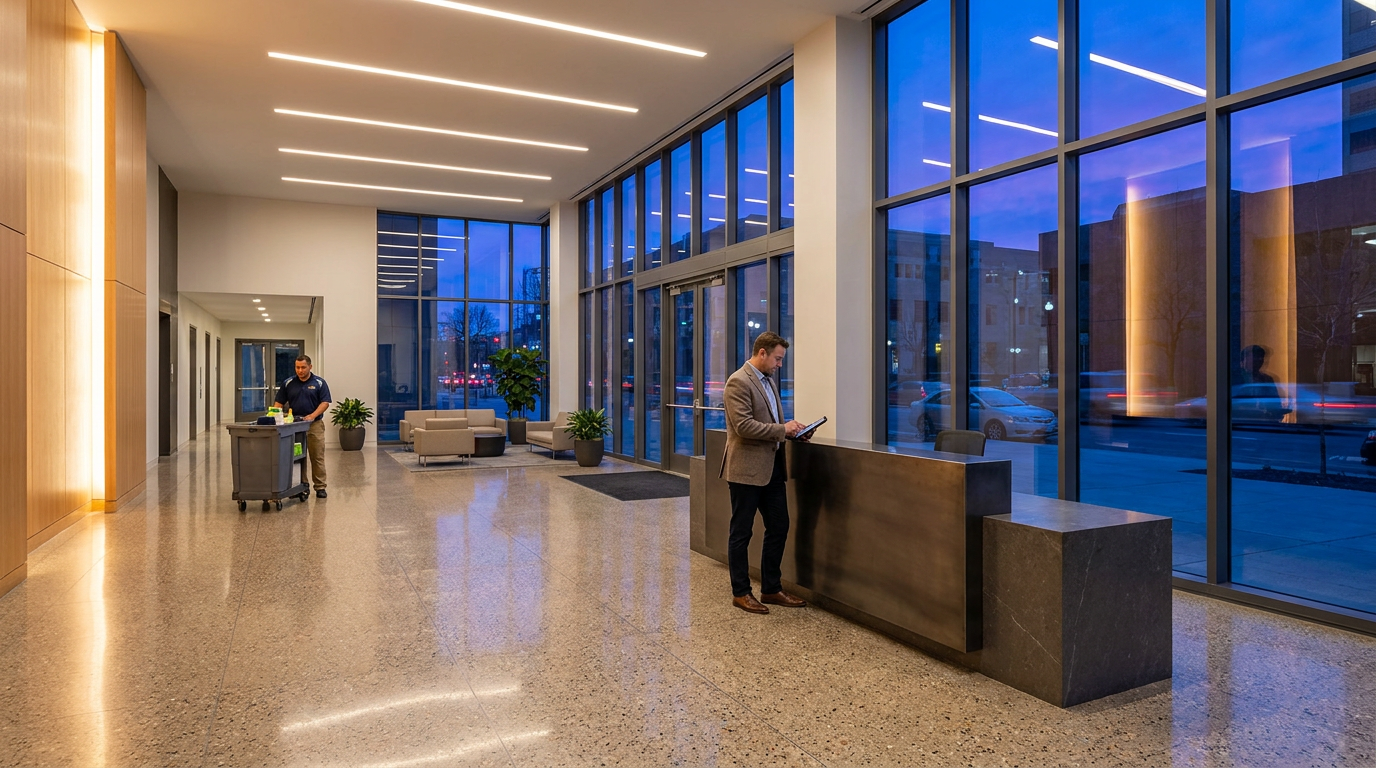
The Operational Reality of Modern Smart Buildings After Hours
Commercial properties do not simply power down when regular tenant hours conclude. Between evening cleaning crews, late-working personnel, third-party maintenance contractors, and overnight delivery logistics, smart buildings sustain significant activity throughout the night. Facility directors and property managers must ensure asset protection, occupant safety, and lease compliance across massive floor plates long after the on-site security console transitions to skeletal staffing.
Traditional building management systems (BMS) often track badge swipes and door contact sensors, but digital logs provide only a fragment of physical reality. An unlocked secondary door, propped loading corridor, or tailgating incident at an access turnstile registers merely as a telemetry anomaly or an ambiguous badge event. Without visual context, on-call property managers are forced to guess whether an alarm signifies an operational oversight or an active security breach.
Achieving dependable smart building after-hours security requires closing the visibility gap between digital access logs and physical actions. Enterprise portfolios require a scalable mechanism to identify unauthorized movement, hazardous conditions, and lease boundary infractions without incurring the prohibitive bandwidth and labor costs associated with manual surveillance.
The Limits of Sensor-Only Building Automation Systems
Modern smart building architectures integrate environmental controls, lighting, and digital access control into unified operational dashboards. While these integrations streamline utility management and HVAC scheduling, their reliance on binary sensory inputs creates severe blind spots for physical security teams. A magnetic reed switch confirms whether a door is technically ajar, but it cannot reveal who propped it open or whether unauthorized visitors walked past it.
Similarly, passive infrared (PIR) motion sensors frequently trigger false alerts in common areas, stairwells, and executive suites. Atmospheric shifts, automated cleaning machinery, or authorized evening service contractors routinely trip motion thresholds, generating alert fatigue that desensitizes response teams. Over time, recurring false positives lead dispatch operators to deprioritize incoming notifications, increasing the likelihood that genuine intrusions remain unaddressed.
To protect physical assets and mitigate operational risk, building leadership must bridge the divide between automated alerts and visual validation. Visual evidence must confirm the intent, identity, and context behind an automated access event before security personnel dispatch mobile patrols or escalate incidents to local authorities.
Why Continuous Video Monitoring Fails After-Hours Teams
When facility operators recognize the shortcomings of binary sensors, the conventional countermeasure is expanding closed-circuit television infrastructure. However, streaming high-definition video from hundreds of internal cameras across distributed commercial towers creates immense infrastructure strain. Continuous video streaming exhausts corporate network bandwidth, incurs staggering cloud storage costs, and demands labor-intensive human monitoring that security budgets cannot sustain.
Human operators monitoring multi-camera display walls experience cognitive fatigue within minutes, missing critical events that occur in remote corridors or subterranean service areas. Furthermore, archiving thousands of hours of unindexed overnight video footage makes post-incident investigations notoriously inefficient. When an incident occurs—such as unauthorized tenant suite access or property damage—investigators spend days scrubbing video timelines rather than taking decisive corrective action.
Modern facility governance requires a transition from passive, bandwidth-heavy video recording to targeted, event-driven intelligence. By extracting visual understanding directly from existing cameras at the moment an anomaly happens, facilities can detect threats immediately without maintaining expensive video transmission pipes.
Structured Snapshot Verification as an Operational Standard
The most effective approach to overnight facility protection combines immediate visual verification with lightweight data transfer. Instead of streaming continuous video feeds, an intelligent operational layer analyzes the video stream locally and extracts precise, high-resolution snapshots only when an operational rule or security boundary is violated. This architecture minimizes data transmission while delivering unambiguous visual proof of the event.
Snapshot-based documentation creates a clear, claim-ready audit trail for property managers, corporate tenants, and risk underwriters. Each visual record captures the exact timestamp, location, and nature of the anomaly—such as unauthorized access after hours, lingering in restricted mechanical rooms, or blocked fire exits. Because each snapshot functions as a standalone piece of evidence, security teams can evaluate and resolve alerts in seconds rather than downloading gigabytes of irrelevant footage.
This methodology streamlines the entire incident response workflow. SOC analysts and property managers receive concise, verified notifications that can be reviewed immediately on mobile devices or integrated incident dashboards. The result is rapid triage, verified dispatch, and zero ambiguity regarding physical compliance across multiple tenant zones.
Preserving Tenant Privacy While Bolstering Building Governance
In shared commercial environments and high-end enterprise properties, occupant privacy is an essential operational requirement. Continuous video monitoring in transition zones, floor lobbies, and multi-tenant elevator vestibules frequently triggers resistance from corporate tenants concerned about employee surveillance and data handling. Traditional video archives create massive data liabilities and expand the surface area for privacy compliance violations under modern data regulations.
Snapshot-only verification fundamentally addresses these privacy concerns. Because continuous video streams are never transmitted or stored, routine tenant activities remain unrecorded. The system functions strictly on an event-driven basis, capturing an image only when an objective security or safety condition is breached, such as an open perimeter door during secure hours or an intrusion into restricted utility infrastructure.
This privacy-first operational model reassures enterprise tenants while providing asset managers with the definitive evidence required to enforce building rules. Facility teams maintain transparent governance, reduce digital liability, and avoid the legal complexities associated with managing long-term video retention policies across large commercial portfolios.
Conclusion
Securing smart commercial facilities after hours does not require ripping out current surveillance investments or deploying proprietary hardware across every tenant floor. Commercial real estate portfolios already possess the necessary camera infrastructure; the challenge lies in transforming those passive endpoints into proactive, privacy-conscious monitoring tools that verify incidents without overwhelming operations teams.
Patrol Sense delivers this modern standard by turning customers' existing cameras into real-time incident detection engines. By generating snapshot-based, claim-ready evidence instead of unmanageable video clips, Patrol Sense empowers property managers to verify after-hours access anomalies instantly, safeguard physical assets, and maintain uncompromising building governance.