Why Schools Rarely Use Airport-Style Metal Detectors
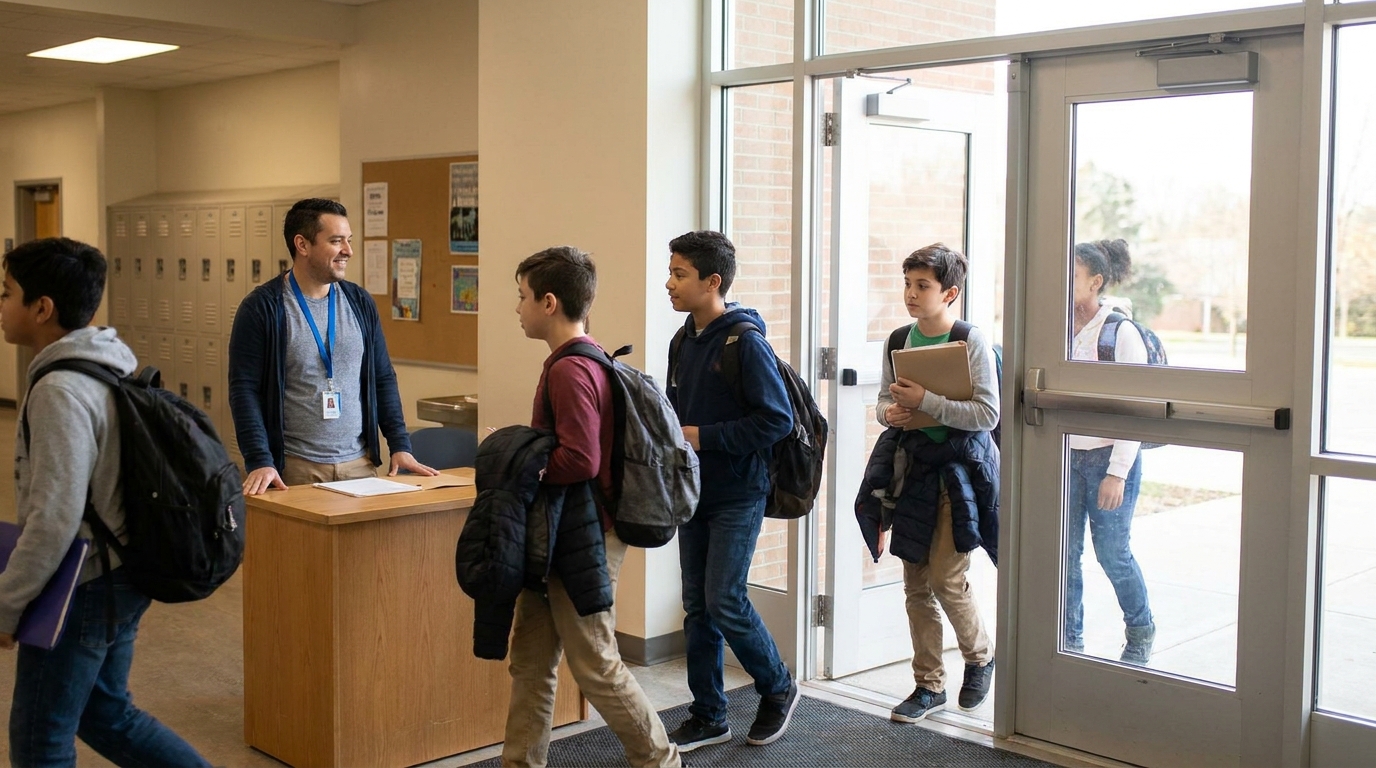
School metal detectors are used in some districts, but most campuses do not copy the airport model because the conditions that make airport screening work do not exist in a school. Airports screen passengers who arrive over a long window, expect to wait, and pass through a single controlled checkpoint. Schools must move hundreds or thousands of students through the doors within a short period before the first bell.
Layout is the second constraint. Many school buildings were designed with multiple entrances, portable classrooms, separate gyms and athletic fields, and doors used by buses, deliveries and events. Screening one door while others stay open creates little protection, and securing every door multiplies the equipment and staff required.
Cost and culture also matter. Equipment, trained operators, bag-search space, and a process for handling alarms all require ongoing budget. Communities differ on whether visible screening supports a sense of safety or changes the learning environment, so decisions are typically made at the district level with input from administrators, parents and local law enforcement.
Walk-Through Detectors: Capability and Operational Load
Walk-through detectors can identify certain metal objects as a person passes through, which is why they are the most recognizable option. In a school, however, students carry laptops, water bottles, belt buckles, binders, musical instruments and sports gear, and many of these items can set off alarms. Every alarm needs a resolution step, and the volume of alarms is often what determines how well a checkpoint runs.
Throughput depends on how many lanes are open, how many staff run them, and how consistently students are asked to empty pockets and place bags on a belt or table. A checkpoint that is under-staffed tends to back up, and a backed-up line creates late arrivals, crowding outside the entrance and pressure on operators to speed up. Schools that use walk-through units usually need to stagger arrival times, open additional entrances, or add lanes.
Detectors also do not address everything. They are not a substitute for bag inspection, they do not cover other doors, and they do not help once a person is inside the building. Directors considering them should plan for the full process, including where flagged students are taken, who conducts secondary checks and how those checks are documented.
Wand Checks and Targeted Screening
Handheld wands require less space and capital than walk-through frames and can be deployed at multiple doors or at events. They can be used on every student, on a random selection or on a defined group such as event attendees. The tradeoff is time, since each person is checked individually and the quality of the check depends heavily on the operator.
Random or selective screening reduces the daily load but raises fairness and consistency questions. Schools using this approach typically write down the selection method, such as a fixed interval or a randomized process, so staff are not choosing individuals by judgment. Policies on physical contact, privacy, same-gender staffing and parental notification vary by jurisdiction, so districts should review them with counsel.
Staffing is the main constraint. Wand checks pull administrators, security officers or trained staff away from supervision and greeting duties during the busiest part of the morning. Training, clear scripts and a consistent escalation path matter as much as the device.
Clear-Bag Policies as a Lower-Friction Option
Clear-bag policies require students to carry backpacks or bags made of transparent material, which makes contents visible at a glance. They are common at stadiums and arenas and are used by some schools, often alongside other measures. Their main advantage is that visual checks happen quickly and without equipment at the door.
The limits are straightforward. A clear bag does not reveal what is on a person or in a pocket, and it relies on compliance, so families need notice, exceptions for medical items and a plan for students who arrive without an approved bag. Some parents also raise privacy concerns about visible personal items, which schools should address in the policy.
Because clear bags reduce the need to open and search bags, they can shorten lines when combined with a wand or a detector. Many districts use them as one layer rather than a standalone control.
Comparing Staffing, Throughput and Disruption
The three approaches sit on a spectrum. Walk-through detectors offer the most systematic screening but demand the most equipment, space and trained operators. Wand checks are flexible and portable but slow and operator-dependent. Clear-bag policies are the lightest to run but cover the least.
When comparing options, it helps to ask the same questions of each: how many entrances must be covered, how many students arrive in the peak window, how many trained staff are available at that time, and what happens to a student who triggers an alarm. A realistic answer to the last question usually reveals whether a plan can run daily without turning into a bottleneck.
Districts should also pilot before committing. A trial at one entrance or at a single event can show line length, alarm rates and staff fatigue using your own building and schedule, which is more reliable than assumptions drawn from another site.
Layering Screening With Detection Inside and Around the Building
No screening method stops every risk, and most safety directors treat entry screening as one layer among several. Other layers include controlled entry points, visitor management, reporting channels for students and parents, door and perimeter monitoring, trained staff and clear emergency procedures. Each layer compensates for gaps in the others.
Cameras are another layer, particularly at doors that are not screened, in parking areas and along perimeters. Their value depends on whether someone is alerted in time and whether the record of what happened is clear afterward. Schools with existing camera systems often find that the practical gap is attention and documentation rather than coverage.
Whatever combination is chosen, document the reasoning. Written procedures, staff training records and periodic reviews of what worked help demonstrate a considered approach and make it easier to adjust when conditions change.
Conclusion
Schools generally avoid airport-style screening because of arrival patterns, building layouts, staffing needs and community expectations, not because screening has no role. Walk-through detectors, wand checks and clear-bag policies each trade coverage against speed and staffing, and the right mix depends on the campus and should be tested before it is scaled.
For the areas that screening does not cover, such as unscreened doors, perimeters and parking areas, Patrol Sense applies AI detection to a school's existing cameras and sends real-time alerts with snapshot evidence, without new hardware. It is meant to complement entry procedures and staff judgment, not replace them, and it can give safety teams a clear, documented record when an incident needs to be reviewed.
Frequently asked questions
Do any schools use metal detectors?
Yes, some districts use walk-through detectors or handheld wands at entrances or at events. Use varies widely by district, and decisions typically involve administrators, local law enforcement and the community.
Are wand checks faster than walk-through detectors?
Not usually for full-student screening, since each person is checked individually. Wands are more portable and cheaper to deploy, which makes them useful for events, secondary checks and selective screening.
Does a clear-bag policy stop weapons from entering a school?
A clear-bag policy makes bag contents visible, but it does not detect items carried on a person or in pockets. Schools typically use it alongside other measures rather than as a standalone control.
What staffing does entry screening require?
Screening needs trained operators at each lane, staff for secondary checks, and a private area to handle flagged students. The exact number depends on the number of entrances and the size of the arrival peak, so a pilot is the best way to estimate it.
Are there legal rules for searching students at school?
Rules on student searches and screening differ by country, state and district, and policy details such as notice and consent should be reviewed with legal counsel. This article offers general information, not legal advice.