Why school entrance security measures vary so widely
Most schools do not use every available measure because each one solves a different part of the entrance problem and adds its own cost, staffing need and operational friction. Metal detectors address what people carry in. Cameras address visibility and review. Controlled doors address where people can enter. No single measure covers all three, and each can slow arrival, strain staff or conflict with life-safety requirements if applied without planning.
The question is common among parents and committee members, and it is often framed as a matter of will. In practice, schools are weighing real constraints: building layout, number of entrances, staffing, budget cycles and the way a campus actually moves at arrival and dismissal. A measure that works in one building may be impractical in another.
Public discussion of the topic tends to list an ideal package: screening, cameras at every entrance, locked doors once classes begin. That list is a useful starting point for a conversation. It is less useful as a standard, because the right mix depends on the site and on what the school can staff and maintain over time.
Screening: throughput, staffing and campus flow
Screening at an entrance concentrates arrivals into a few points. A campus built with many doors, portable classrooms or open walkways cannot easily funnel everyone through one checkpoint. Even on a compact campus, the line forms at the same moment every morning, and the school has to decide how much instructional time and student comfort it is willing to trade for it.
Screening also needs trained people operating it consistently. Staff have to be present at every open screening point, have a clear process for alarms and know how to handle exceptions such as visitors, deliveries and late arrivals. When staffing is thin, the process can degrade quietly, which is worse than having a plan that the school can sustain.
Screening does not cover other points of entry or the time outside the arrival window. Events, after-school programs and sports often bring people onto campus when the checkpoint is not running. Committees should ask what the measure covers, when it runs and what happens in the gaps.
Entrance cameras: coverage is easy, attention is hard
Cameras are the most widely deployed of the three measures because they are relatively simple to install and do not slow students down. The harder question is who looks at them and when. A camera pointed at an entrance records activity, but if nobody is assigned to watch it or review it, its value is mostly after the fact.
Camera placement also involves decisions about student privacy, where cameras may not be appropriate and who may access the images. Those rules vary by district and jurisdiction, and they are better settled in policy before a system is expanded than after. Districts that treat cameras as an operational tool, with a named owner and a review process, generally get more from the same hardware.
Maintenance matters as well. Cameras go offline, move out of position or lose clear views because of lighting and obstructions. A system with a few failed cameras may look complete on a floor plan while leaving real entrances uncovered.
Controlled doors and the egress question
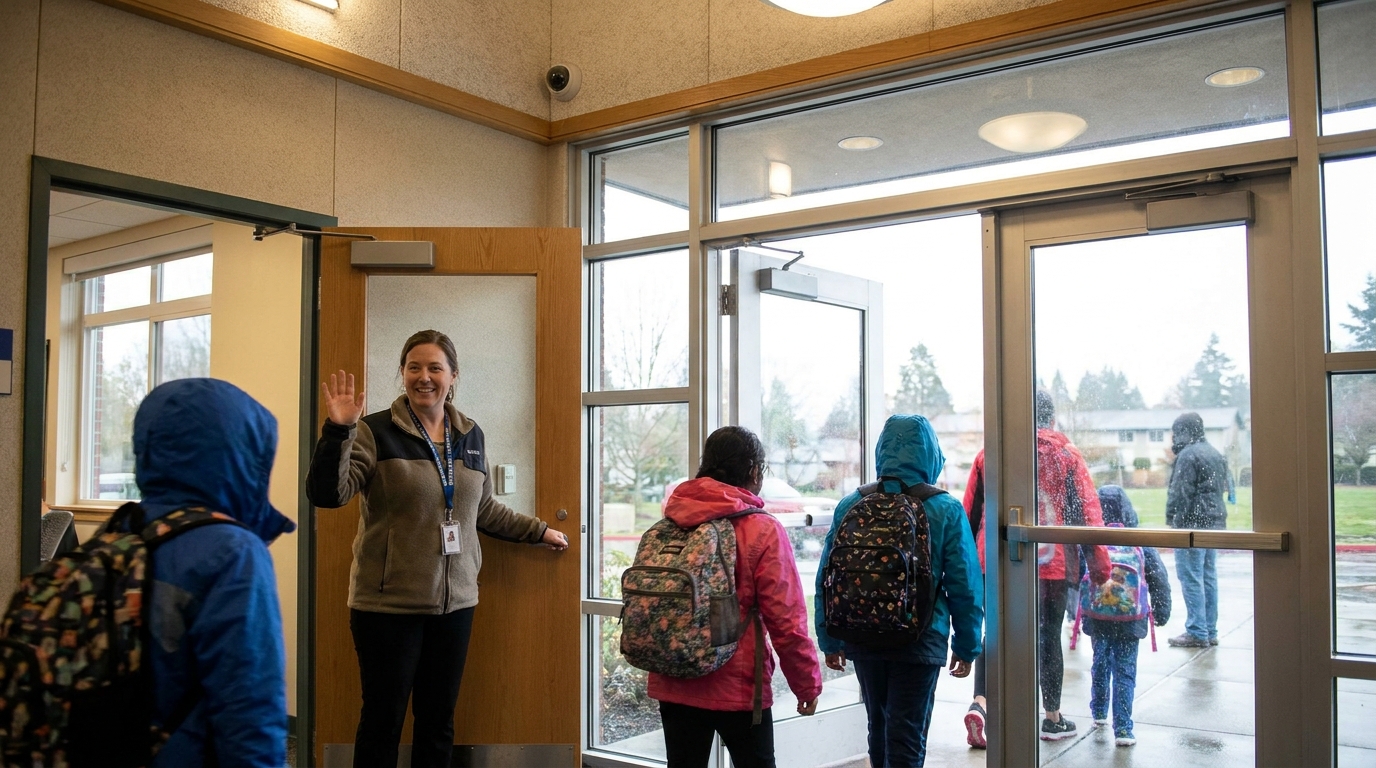
Keeping most doors secured during the school day and directing visitors to one monitored main entrance is a well-understood principle. It reduces the number of places that need attention. The practical difficulty is that students and staff must always be able to leave quickly in an emergency, and fire and life-safety rules govern how doors can be locked, held or alarmed. Those rules differ by jurisdiction, so any change to door hardware should involve the local authority and the school's facilities team.
Controlled doors also depend on daily habits. A door propped open for a delivery, a student letting a friend in or a staff member stepping out without checking the latch can undo the control. Door alarms and clear procedures help, but they require someone to respond when an alert occurs.
Visitor management at the main entrance adds a further layer. A vestibule with a front office window and a check-in process can work well, but it needs staff who can see the entrance and are not pulled away during busy periods.
The cost is more than the purchase price
Budget discussions often focus on equipment cost, but the ongoing costs are what determine whether a measure lasts. Screening needs people, training and space. Door control needs hardware upkeep, procedures and sometimes renovation. Cameras need storage, network capacity, maintenance and someone to review what they capture. A measure that is funded once but not staffed or maintained can create a false sense of coverage.
Districts also have to weigh competing needs such as counselors, mental health support, facility repairs and instructional resources. Physical security spending is one of several approaches to reducing risk, and committees are right to ask what each option actually changes. A useful question for any proposal is what problem it solves, who runs it every day and what it will cost to keep running in year three.
Where existing cameras can support incident verification
Many schools already have cameras at entrances, hallways and parking areas. The gap is often not coverage but attention: staff cannot watch every feed, and incidents are usually reconstructed afterward from whatever was recorded. Adding detection and alerting to the cameras already in place can help a small team learn about an event sooner and confirm what happened without searching through hours of recordings.
A practical approach is to define a short list of events the district cares about at each site, such as propped or forced doors, after-hours entry or activity in restricted areas. Alerts should carry a clear still image so a staff member can quickly judge whether the situation is real. Snapshot evidence of this kind also gives administrators and insurers a consistent record of what was seen and when, which supports review and any later claim.
This does not replace screening, door hardware, trained staff or response plans. It adds a layer of verification to the infrastructure a school already owns, and it works best when the district has settled who receives alerts, who decides what to do and how images are retained and shared under local policy.
Conclusion
Schools adopt different combinations of screening, cameras and door control because each measure trades protection against cost, staffing, campus flow and life-safety requirements. The most useful committee conversations ask what each option covers, who operates it daily and what it will cost to sustain. Existing cameras are often an underused part of the answer, particularly for verifying incidents quickly.
Patrol Sense turns a district's existing cameras into real-time incident detection with snapshot-based evidence, a multi-site dashboard and camera health monitoring, without proprietary hardware. For districts weighing entrance measures, it offers a way to improve visibility and documentation across campuses while the broader decisions on screening and door control are worked out locally.
Frequently asked questions
Why don't all schools use metal detectors?
Screening requires trained staff, dedicated space and time at every open entrance, and it can slow arrival on campuses with many doors. It also does not cover other entry points or periods outside the screening window. Schools weigh these factors against their layout and resources.
Do cameras at school entrances prevent incidents?
Cameras provide visibility and a record, but their value depends on whether someone reviews or responds to what they capture. Placement, maintenance and clear privacy and access policies also matter. Cameras work best as one part of a broader plan.
Why can't schools simply lock every door during the day?
Securing most doors and routing visitors through a monitored main entrance is a common principle. However, students and staff must always be able to exit quickly in an emergency, and life-safety rules govern how doors can be locked or alarmed. Requirements vary by jurisdiction, so changes should involve local officials and facilities staff.
What questions should a school safety committee ask before adding a security measure?
Useful questions include what specific problem the measure addresses, who operates it every day and what it costs to maintain beyond the initial purchase. Committees should also ask what it does not cover and how it fits with door procedures, staffing and response plans.
How can existing school cameras help with incident verification?
AI detection can be applied to cameras a school already owns so staff receive alerts with a still image and can quickly judge whether an event is real. Snapshot records of what was seen and when support internal review and any later claim. Retention and sharing should follow district policy and local rules.