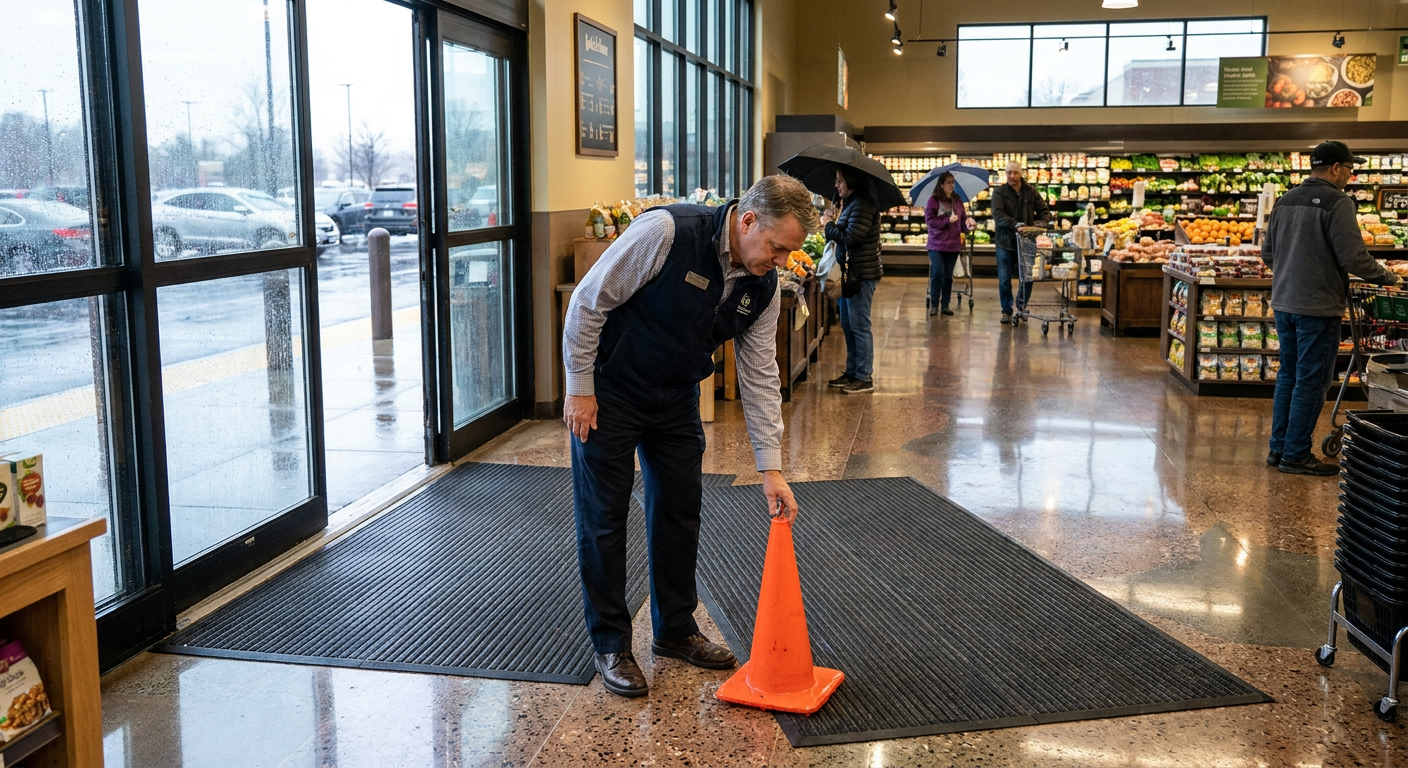
The Economic Burden of Premise Liability in Retail
Retail environments operate under constant foot traffic where transient hazards—such as tracked-in rainwater, leaking refrigeration units, or dropped liquids—present recurring safety liabilities. According to commercial claims adjusters, slip and fall incidents represent one of the largest drivers of preventable general liability expenses for physical retailers.
Defending against these claims requires demonstrating reasonable care and adherence to standard inspection protocols. When records depend exclusively on paper sweep logs or delayed staff reporting, retailers struggle to substantiate their maintenance timeline during discovery.
Without verifiable visual records of surface conditions immediately preceding an incident, risk managers frequently settle questionable claims rather than incur compounding defense litigation costs.
Limitations of Continuous Video Review for Defense Workflows
Most commercial retail locations maintain extensive closed-circuit camera networks, yet extracting defensive evidence remains structurally inefficient. Security personnel often must comb through hours of continuous video footage across multiple camera streams to establish when a spill occurred or when staff last inspected the aisle.
Continuous video storage creates substantial cloud and server bandwidth burdens, prompting many operators to retain footage for only thirty to sixty days. This retention window frequently expires before a claimant officially files a formal claim or legal demand.
Furthermore, distributing unredacted, massive video files to insurance carriers, independent adjusters, and defense counsel introduces privacy exposure and digital chain-of-custody complications that delay claims resolution.
Establishing Constructive Notice with Snapshot-Based Timelines
In premise liability litigation, establishing whether a retailer had actual or constructive notice of a hazard dictates liability exposure. Constructive notice hinges on whether a hazard existed long enough that regular operational oversight should have discovered and remediated it.
Automated visual verification transforms this evidentiary threshold by generating discrete, timestamped snapshots of floor conditions at defined intervals. Rather than relying on staff recollection, operators obtain an objective timeline showing clean surfaces leading up to the incident.
These cryptographic image sequences clearly delineate between a sudden spill that occurred seconds before a fall and an unattended condition that sat unaddressed. This precision equips defense teams with factual backing to counter negligence assertions.
Optimizing Operational Response Across Distributed Store Footprints
Effective risk management extends beyond post-incident defense into immediate hazard awareness. Automated detection applied to overhead feeds can identify anomalies such as fallen merchandise, wet floor markers, or unexpected obstructions in high-traffic transition zones.
When floor irregularities are visually flagged, store managers receive instant visual alerts, allowing floor teams to address the risk before customer contact occurs. This closed-loop response shifts store operations from passive monitoring to structured risk reduction.
Because the workflow relies on lightweight image snapshots, field supervisors and district risk leads can review notifications across dozens of locations simultaneously without overloading operational bandwidth.
Preserving Privacy and Streamlining Claims Admissibility
Modern enterprise governance requires strict compliance with customer privacy and data security mandates. Snapshot-based documentation inherently mitigates privacy liabilities because it captures targeted evidentiary records rather than continuous behavioral streams of customers and employees.
Each generated snapshot includes verified metadata, cryptographic hashing, and immutable timestamps that satisfy digital evidence admissibility standards. These compact evidentiary packages can be securely transmitted directly to third-party administrators and legal teams within minutes.
By presenting claims handlers with clean, verified snapshot sequences rather than disjointed video files, retailers accelerate liability determinations and avoid prolonged claims administration costs.
Conclusion
Defending retail margins against escalating premise liability claims requires operational defensibility built on verified facts. By leveraging existing surveillance infrastructure, retailers can modernize risk oversight without investing in costly rip-and-replace hardware programs.
Patrol Sense enables retail enterprises to convert standard camera networks into active safety and documentation assets. By capturing snapshot-only, claim-ready visual evidence when incidents occur, Patrol Sense provides risk managers with the defensible proof needed to mitigate liabilities, protect operating capital, and maintain safer retail spaces.