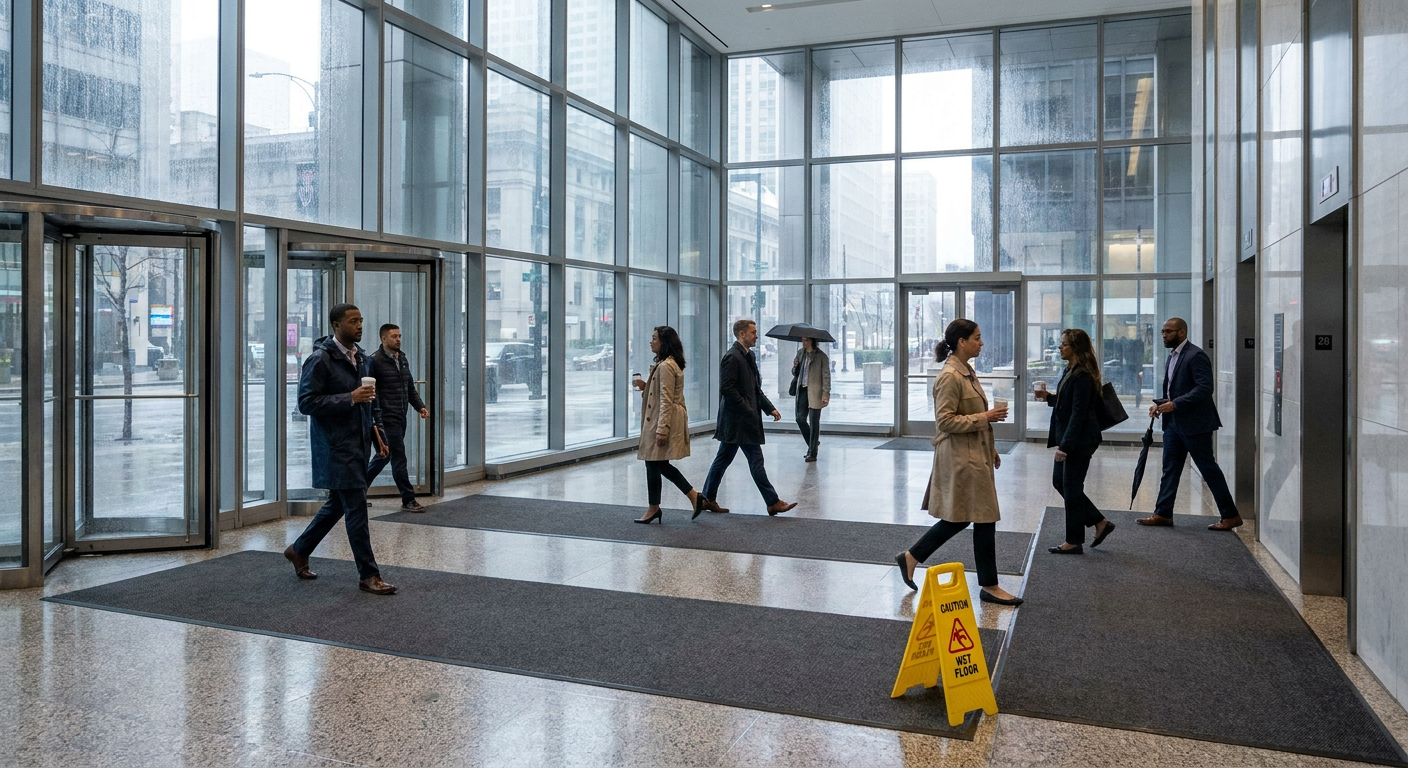
The Transitory Nature of Wet-Weather Floor Hazards
Rainstorms and sudden snowmelt create rapid shifts in building risk profiles. As foot traffic enters a high-volume commercial tower or civic building during morning peak hours, water tracks across vestibules faster than standard walk-off mats can absorb it. In less than fifteen minutes, a dry entrance can transition into a low-friction surface that poses immediate danger to occupants.
Traditional risk mitigation relies heavily on static defense measures such as absorbent matting, umbrella bags, and fixed warning signage. While these controls are essential, they do not account for saturation thresholds or mat displacement caused by heavy luggage, delivery carts, and foot volume. When an entrance mat folds or shifts onto smooth tile, the protective measure itself becomes an unexpected tripping hazard.
Understanding how quickly surface friction degrades under variable weather conditions is critical for enterprise safety teams. Without continuous awareness of environmental changes at ingress points, facilities remain vulnerable to both sudden accidents and the prolonged litigation that often follows.
Why Paper Janitorial Logs Fail Under Legal Scrutiny
For decades, property managers have defended against premises liability claims using paper maintenance logs. A janitorial technician initials a clipboard hourly, documenting that the entryway was inspected, mopped, and equipped with warning cones. However, opposing counsel routinely challenges the veracity and timing of these manual entries in court.
Paper records are inherently vulnerable to human error, missed intervals, and retroactive completion. Even when staff execute rounds diligently, a slip and fall event occurring forty minutes after an inspection leaves a substantial evidentiary void. Defense attorneys struggle to prove that the hazard arose too quickly for staff to act under the legal standard of constructive notice.
Jurors increasingly expect concrete, time-stamped proof rather than generalized testimony about standard operating procedures. When a facility cannot verify the exact state of a floor leading up to an incident, settlements often become the only viable financial path regardless of actual maintenance diligence.
The Operational Gap Between Scheduled Cleanings
Commercial operations cannot justify stationing a dedicated porter at every entrance door throughout an eight-hour shift. Facilities operate under lean staffing models where maintenance teams rotate across multiple floors, restrooms, and exterior grounds. This leaves entryway condition tracking unmonitored during the precise intervals when weather conditions worsen.
When sudden squalls strike, water accumulation accelerates before teams can respond. By the time a tenant notifies the front desk or a scheduled sweep occurs, hundreds of pedestrians have already navigated slick transition zones between carpeted runners and polished stone. This operational delay is where the vast majority of premises exposure originates.
Bridging this gap requires immediate operational awareness when hazardous conditions develop. Facility managers need mechanisms that alert teams to water pooling, displaced floor mats, or absent warning cones without forcing personnel to watch continuous camera feeds.
Establishing Defensible Timelines With Snapshot Verification
Resolving liability claims effectively depends on presenting an unbroken, tamper-evident timeline of property conditions. Modern risk governance favors granular, time-stamped visual records that capture the lifecycle of a hazard from appearance to remediation. Static visual snapshots provide clear proof of when rain began, when signage was deployed, and how quickly maintenance arrived.
Unlike bulky video recordings that require hours of scrubbing and expensive digital storage, structured snapshots deliver focused, claim-ready documentation. A sequence of visual records demonstrates reasonable care by proving the exact duration a condition persisted before staff corrected it. This targeted visual paper trail simplifies claims handling for adjusters and defense counsel.
Furthermore, snapshot-based documentation eliminates ambiguous visual interpretations. Adjusters receive clear photographic milestones showing the placement of mats, floor conditions, and prompt staff intervention, allowing claims to be validated or dismissed rapidly without prolonged legal discovery.
Protecting Pedestrian Privacy in High-Traffic Zones
Monitoring public and tenant spaces introduces stringent data privacy obligations. Commercial properties, healthcare facilities, and academic institutions face intense scrutiny regarding continuous video surveillance, facial recognition, and personal data storage. Comprehensive video archives often create compliance burdens under emerging state and municipal privacy standards.
Capturing periodic environmental snapshots rather than continuous video streams significantly reduces regulatory exposure. Snapshot workflows document floor conditions, mat placement, and safety assets without archiving continuous behavioural footage of occupants. This privacy-by-design approach satisfies enterprise compliance officers while safeguarding visitors.
Limiting visual retention to incident-relevant contextual snapshots also minimizes corporate cyber risk. Because the organization does not maintain massive repositories of continuous public surveillance footage, the potential exposure from data breaches or third-party subpoenas is drastically curtailed.
Conclusion
Managing the physical risks introduced by inclement weather demands a transition from reactive cleanups to verifiable operational control. Commercial property managers can no longer rely on unverified paper logs to defend against costly premises liability claims. Building defensible operations requires automated hazard awareness and permanent, objective documentation of entryway conditions.
Patrol Sense empowers enterprise facility operators to transform their existing security cameras into proactive risk governance tools without installing proprietary hardware. By analyzing environmental changes in real time and capturing snapshot-only, claim-ready documentation, Patrol Sense ensures maintenance teams resolve entryway hazards promptly while providing legal teams with immutable visual proof of due care.