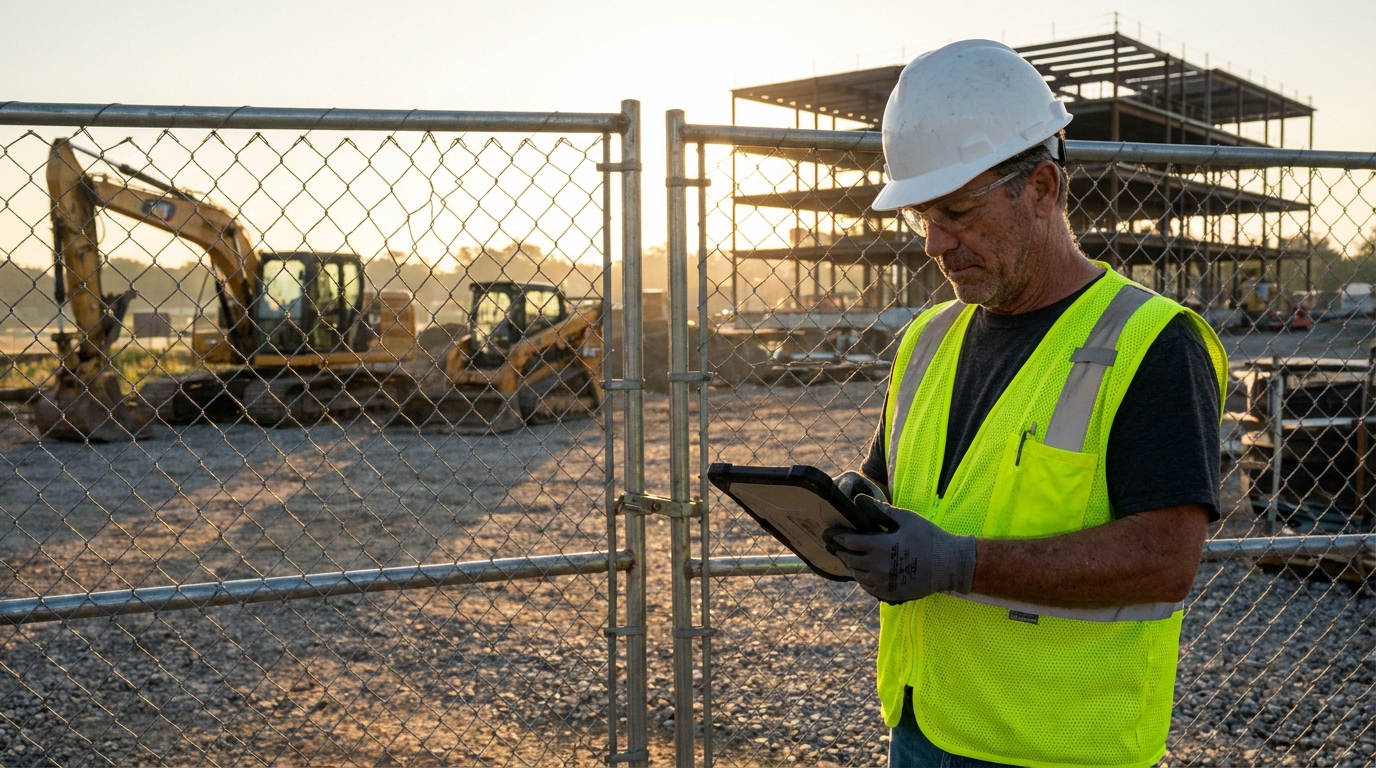
What Construction Site Equipment Theft Prevention Actually Requires
No single measure keeps a jobsite secure. Effective construction site equipment theft prevention combines several layers: controlling who can enter, knowing exactly what equipment and materials are on site, tracking high-value assets, making the site visible after dark, checking it regularly, and documenting every incident so it can be acted on and claimed.
Each layer covers a weakness in the others. A fence can be cut, a tracker can be removed, a light can be avoided, and a patrol can miss a short window of activity. Together they raise the effort and the risk of being identified for anyone considering theft or unauthorized use.
The sections below follow that order, with practical steps a construction manager or fleet manager can apply to a single site or a portfolio of projects.
Control Who and What Enters the Site
Start with a defined perimeter and as few entry points as the workflow allows. Every additional gate is another point to lock, light and monitor. Keep a single main entrance for workers and deliveries, and secure any secondary gates outside working hours with locks that are checked, not just installed.
Add a simple access routine. Keep a current list of authorized workers and subcontractors, require sign-in for visitors and delivery drivers, and remove access promptly when a trade finishes its scope. Where practical, use credentialed gates or keyed padlocks with a record of who holds each key.
Unauthorized use is often an inside-the-gate problem rather than a break-in. Equipment keys left in machines, shared ignition keys and unlocked fuel tanks make misuse easy. Assign keys to named operators, store them in a lockable box at the end of each shift, and park equipment in a defined, lit area rather than where work ended.
Know Exactly What You Own and Where It Should Be
Theft is hard to prove and harder to claim without a clear inventory. Maintain a register of every machine, attachment and major tool, including make, model, serial or product identification number, photographs, and the assigned site and operator. Keep this register off site so it remains available if a site office is broken into.
Check the register against reality on a schedule. A short end-of-day count of what is in the yard, and a fuller weekly reconciliation, will surface missing items sooner than a discovery at the start of the next phase. Early discovery narrows the time window for investigation and for reviewing any available imagery.
Mark equipment visibly and discreetly. Painted fleet numbers, engraved identification and hidden tags help recovery and identification, and visible marking can also discourage resale. Record where tools and small items are stored, and use lockable containers for materials and tools that are easy to carry.
Use GPS Tracking for Mobile Assets, and Understand Its Limits
GPS or telematics trackers are well suited to larger mobile assets such as excavators, loaders, trailers and generators. They help locate a machine after it leaves the site, and many systems can alert you when an asset moves outside a set area or outside working hours. For fleet managers they also provide a record of location and usage that supports inventory control.
Trackers have limits. A device that is easy to find can be removed, a signal can be lost in a container or a covered area, and a tracker does not tell you who took the machine or how they got in. Conceal units in more than one location where possible, and check that devices are reporting, because a dead battery or a disconnected unit gives false confidence.
Treat tracker alerts as part of a response plan. Decide in advance who receives an after-hours movement alert, who confirms whether the movement is authorized, and when law enforcement is contacted. An alert nobody owns tends to be ignored until the next morning.
Light the Site and Check It at Sensible Intervals
Good lighting makes activity visible and makes it harder to work unnoticed. Focus on entry points, equipment parking, material storage and the fence line, and avoid leaving large dark pockets between lit areas. Position lights so that they illuminate the area without creating glare that blinds cameras or guards, and protect fixtures and power supplies from tampering.
Patrols add judgment that fixed measures cannot. Whether you use in-house staff, a guard service or periodic supervisor walk-throughs, vary the timing so the pattern is not predictable, and give patrol staff a short checklist: gates and locks, fence condition, equipment count, fuel and key storage. Record each check, even briefly, so there is evidence the site was inspected.
Existing or temporary cameras can extend coverage between patrols, especially on sites that are too large or remote to watch continuously. The practical value depends on placement, lighting and whether someone receives and acts on alerts. Cameras that only record are useful after the fact; cameras that notify the right person soon enough can support a real-time response.
Document Incidents So Response and Claims Hold Up
When something does go wrong, the first hour matters. Write down the time the problem was found, secure the area, check the inventory against the register, and review any gate records, tracker data and camera imagery covering the relevant window. Notify law enforcement and your insurer or broker according to your policy requirements, and keep a log of who was contacted and when.
Preserve the evidence before it is lost. Save still images or other records tied to the event, note the camera and time they came from, and avoid altering originals. Insurers and investigators generally want a clear timeline, proof of ownership, and proof of the value of the missing items, so the equipment register and serial numbers are directly useful here.
After the incident, review what failed. Was a gate left open, a key unaccounted for, a light out, or an alert not answered? Record the finding and the corrective action, and apply it across your other sites. This turns each incident into an improvement to the whole program rather than an isolated loss.
Conclusion
Protecting construction sites and equipment depends on layering: controlled access, an accurate inventory, tracking for mobile assets, visible lighting, regular checks and a documented response. None of these needs to be elaborate, but each needs an owner and a routine. Sites that do the basics consistently are typically harder targets than sites with one expensive measure and gaps around it.
For teams that already have cameras on or near their sites, Patrol Sense applies AI detection to those existing cameras, sends real-time alerts when an incident such as an intrusion is detected, and stores snapshot-based evidence that can support an incident log or a claim. It does not require new hardware, and a multi-site dashboard and camera health monitoring help managers see that coverage is working across projects. Whatever tools you choose, the aim is the same: notice problems sooner, respond with a clear process, and keep records that stand up afterwards.
Frequently asked questions
What is the most effective way to prevent equipment theft on a construction site?
No single measure is enough, so the most effective approach is a combination of access control, secure key and equipment storage, tracking, lighting and regular checks. Each layer covers gaps in the others. Consistency matters more than any one product.
Do GPS trackers stop construction equipment from being stolen?
Trackers mainly help locate equipment and alert you to unauthorized movement; they do not physically prevent a theft. They work best when hidden, tested regularly and tied to a plan that names who responds to an alert. A visible or neglected tracker may be removed or fail without anyone noticing.
How can I reduce unauthorized use of equipment by people who are already on site?
Assign keys to named operators, store them in a locked box at the end of each shift, and secure fuel and attachments. Keep a register of who is authorized to run each machine and review it as trades change. Telematics usage data can help identify operation outside normal hours.
What records should I keep for an equipment theft insurance claim?
Keep an equipment register with serial or product identification numbers, photos, ownership documents and values, plus a timeline of when the loss was discovered. Retain any gate logs, tracker data, patrol records and camera images tied to the event. Requirements vary by insurer and policy, so confirm them with your broker.