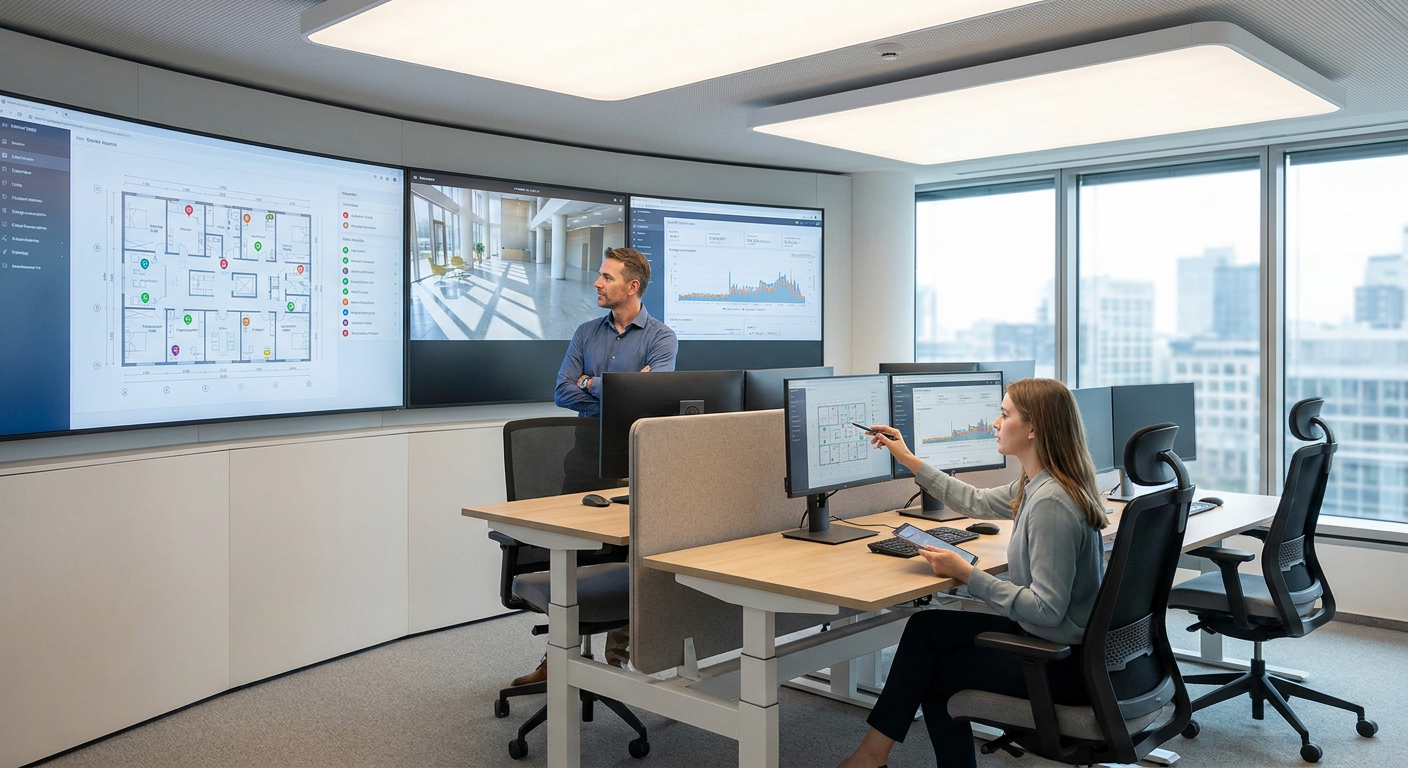
The Evolving Landscape of Smart Building Security
Modern smart buildings are complex ecosystems of interconnected technologies. From HVAC and lighting to access control and energy management, these systems are designed to enhance efficiency, comfort, and sustainability.
However, this interconnectedness also introduces new security vulnerabilities. The challenge for facility managers is to protect these diverse operational technologies (OT) and Internet of Things (IoT) devices without disrupting their intended function or requiring extensive, proprietary hardware overhauls.
Traditional security approaches often treat physical security as a separate layer, creating operational silos. This fragmented view can lead to blind spots and delayed responses when incidents occur across multiple systems.
Bridging the Gap: AI for Seamless Systems Integration
The true potential of smart building security lies in its integration with the broader building management system (BMS). AI offers a powerful solution to unify these disparate data streams, creating a cohesive security posture.
Instead of siloed alerts from individual sensors, AI can correlate data from existing cameras with inputs from access control, environmental sensors, and even energy usage patterns. This holistic view enables more sophisticated threat detection and anomaly identification.
By leveraging existing infrastructure, AI platforms can convert ordinary security cameras into intelligent sensors that contribute to the overall building intelligence, without the need for costly hardware replacements.
Proactive Threat Detection and Anomaly Recognition
AI's ability to learn normal operational patterns is critical for proactive security. It can establish baselines for typical activity within a building, identifying deviations that might indicate a security concern.
For example, an unusual number of access attempts outside business hours, combined with an unexpected presence detected by a camera in a restricted area, can trigger a high-priority alert. This multi-factor analysis significantly reduces false positives.
This capability extends beyond traditional security events, allowing for detection of anomalies that could signify equipment malfunction, unauthorized access to utility closets, or even unusual crowd formations in common areas.
Enhanced Operational Efficiency Through Unified Data
Integrating AI security with building systems delivers significant operational benefits. Facility managers gain a centralized dashboard that provides real-time insights into both security incidents and operational performance.
This unified data stream allows for more informed decision-making and optimized resource allocation. For instance, understanding the correlation between security alerts and building system statuses can help pinpoint root causes more quickly.
Automated incident documentation, based on AI-generated snapshots, streamlines reporting and compliance processes, freeing up personnel for more critical tasks rather than manual data entry.
Robust Incident Response and Audit Trails
When an incident occurs, integrated AI security systems can trigger immediate, automated responses. This could include locking down specific areas via access control, adjusting lighting, or alerting on-site personnel and emergency services.
The snapshot-based evidence captured by AI provides a clear, time-stamped record of events. This granular data is invaluable for post-incident analysis, legal proceedings, and continuous improvement of security protocols.
Comprehensive audit trails, combining security events with operational data, offer an unassailable record for compliance reporting and internal investigations, ensuring transparency and accountability.
Future-Proofing Smart Buildings with Adaptive AI
The modular and adaptive nature of AI security platforms ensures that smart buildings can evolve without constant security overhauls. As new sensors or building management systems are introduced, AI can integrate their data feeds.
This flexibility allows organizations to incrementally upgrade their security posture, leveraging existing camera infrastructure as the foundation for an intelligent security ecosystem.
An AI-first approach positions smart buildings to be more resilient against emerging threats and operational challenges, fostering a safer and more efficient environment for occupants and assets.
Conclusion
As smart buildings continue to integrate advanced technologies, the need for a unified and intelligent security framework becomes paramount. AI is not just an add-on; it is the connective tissue that transforms disparate building systems into a cohesive, proactive security intelligence platform.
By bridging the gap between physical security and operational technology, AI enables facilities to achieve unprecedented levels of safety and efficiency. Organizations seeking to maximize their existing infrastructure and enhance their smart building capabilities can leverage advanced AI solutions to achieve this integration.
Patrol Sense empowers businesses to unlock the full security potential of their existing camera systems, providing real-time incident detection and verifiable snapshot-based evidence, seamlessly integrating with the broader smart building environment without requiring proprietary hardware.